
Without ethnic minority groups, the United States would have no culture because white Christian culture by itself is no culture. Given its various characteristics, such as location, population, economics, etc., the Midwest is a good region to analyze to better understand the country as a whole.
The midwestern states are: Illinois, Indiana, Iowa, Kansas, Michigan, Minnesota, Missouri, Nebraska, North Dakota, Ohio, South Dakota, and Wisconsin. The Midwest can be divided into two subregions: the Northwest Territory (also known as the Old Northwest) and the Great Plains. States in the Northwest Territory are Indiana, Illinois, Michigan, Ohio, and Wisconsin, and the rest, Iowa, Kansas, Minnesota, Missouri, Nebraska, North Dakota, and South Dakota, belong to the Great Plains.
Based on the July 2017 census, the largest city in the entire Midwest is Chicago, Illinois, which unsurprisingly also has the largest metropolitan area. Given its sheer size and diversity, Chicago is more similar to New York City or Los Angeles than other midwestern cities. It is also part of the Northwest Territory.
Minneapolis Culture
Outside of Chicago, arguably no other midwestern city boasts a truly vibrant culture aside from Minneapolis, Minnesota. It ranks eighth among the largest cities and third for the largest metropolitan area. Minneapolis is actually one of the two “Twin Cities,” with Saint Paul being the other city, which ranks twelfth.
Minneapolis has grown and changed dramatically in its recent history, and it now ranks among the most cultured cities in the country. Where does this culture come from? The answer is that it does not come from white Christians. It comes from its ethnic minorities.
Food Culture
Without its ethnic minority groups, again the people who are not white Christians, the city of Minneapolis and its inhabitants would still be eating lefsa and lutefisk, not that there is anything wrong with them as cultural legacy, but there is just not much demand for the rather crude culinary offerings.
Neither is there much culinary sophistication in “hotdish,” also known as casserole, hotdogs and burgers, the last two being originally German fare. They are all now standard American fare, but they so ubiquitous that they, by themselves, cannot create a culinary culture.
Eat Street, which runs along Nicollet Avenue, starting just outside its downtown district, is one of the most well-known streets in Minneapolis for food. It hosts a variety of restaurants but is dominated by Asian ones.
The restaurants are supported by farmers markets and a growing farm-to-table movement, giving minority groups, such as the Hmong, a way to maintain their traditional livelihoods. (Obviously, many restaurants in the city have come under financial pressure due to the shutdown in response to the pandemic.)
Nelson (2019) writes, “Restaurants have always been on the front lines of the melting pot in this country. Twin Cities diners can circumnavigate the globe several times over and never leave the seven-county metro area. Culinary traditions spanning every continent — Indonesia to India, Morocco to Mexico, Somalia to Singapore — are represented here in restaurants and markets, a breadth and depth unimaginable 20 years ago.”
Long Live the Arts
However, food alone does not a culture make. There are many cities in diverse parts of the country, for example Southern California, with well-developed food cultures that still lack a strong overall culture. Also, many Americans mistake entertainment for culture. Sports are entertainment. They are not a key contributor to a city’s culture.
The arts and a vibrant arts community are absolutely critical to creating an authentic local culture. The Minneapolis arts scene thrives in all forms: fine arts, theater, music, dance, local activities and festivals, often using its well-maintained public parks and lakes, which are also an investment, as its venues. It is not just about art for art’s sake but art for the sake of having a living city, a city that has a sense of cultural purpose, not just a city in which one lives.
Minneapolis Music Culture – Bob Dylan and Prince
The two most famous people to come out of the state are Bob Dylan and Prince. Bob Dylan, originally named Robert Allen Zimmerman, was born to a Jewish family in Duluth, MN and raised in Hibbing, MN. He later moved to Minneapolis to study at the University of Minnesota. After dropping out of college, he moved to New York City, where he started and made his musical career. As an aside, Bob Dylan was inspired by Woody Guthrie, whose life and music should be reflected upon more, particularly as it relates to class, race relations and equality.
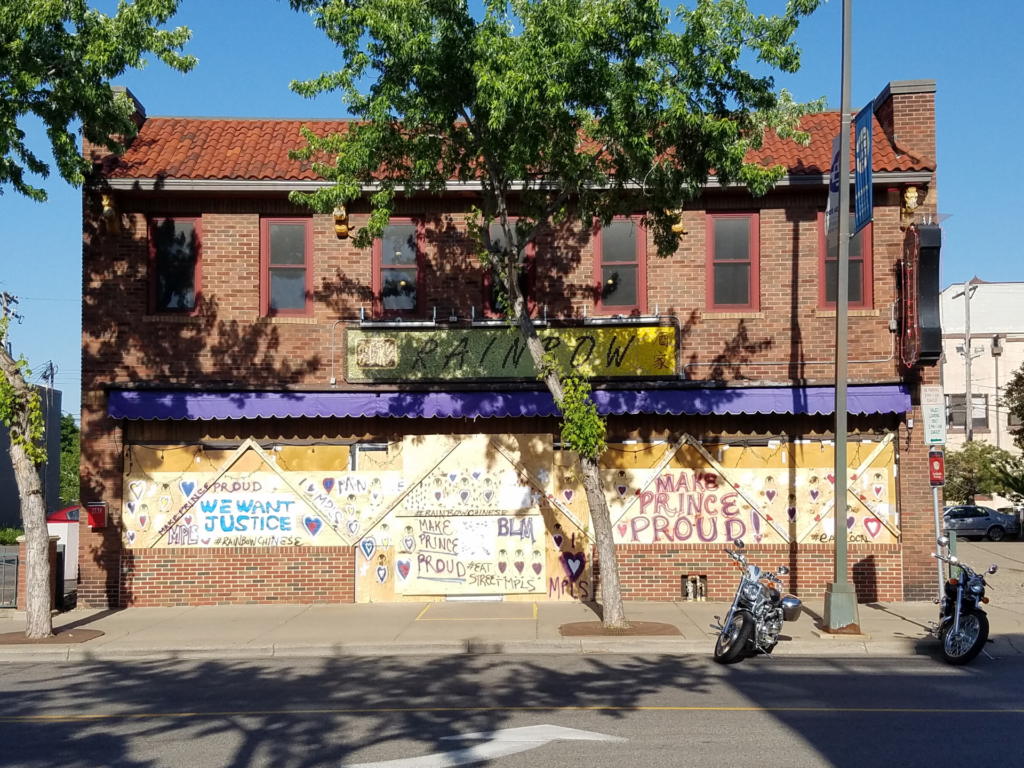
Prince was born Prince Rogers Nelson in Minneapolis. He rose to stardom on sheer tenacity, savvy and talent, as a racist music industry once refused to allow him and other black musicians, such as arguably the most famous musician in the world at the time, Michael Jackson, to air their music videos on MTV. Prince’s exploitation by said music industry led him to change his name from his birth name to a symbol (a combination of male and female symbols) in 1993 until he changed it back in 2000.
Unlike Dylan, who left Minneapolis, Prince maintained his residence in the city, technically the suburb of Chanhassen, where his home and studio, Paisley Park are located. He hosted parties there, and he would sometimes show up at them or other music events in the city. He loved Minneapolis, and the city loved him. His untimely passing in 2016 at the age of 57 was one of the city’s great heartbreaks.
It is poetic justice that the city’s and state’s proudest native sons are a black man and a Jewish man, respectively. As the racist-tweeting, Eric Metaxas even somewhat concedes, Martin Luther, for his justified opposition to the corrupt Catholic Church was unjustifiably opposed to the people who actually gave us Christianity.
Given the large Lutheran population in Minnesota, it is sadly unsurprising that Minneapolis was once known as the “capitol of anti-Semitism,” and the city has also had a history of discrimination against its black residents, particularly related to housing. Dylan’s song Desolation Row starts by referring to the lynching of black men at the hands of depraved white people in Duluth, Minnesota.
Update: Their murder occurred 100 years ago today, June 15, 2020. A message from Gov. Walz: “To truly be One Minnesota, we need to dismantle the systems of oppression that led to the deaths of Clayton, Jackson, and McGhie 100 years ago, and that led to the death of George Floyd just 3 weeks ago. Today I met with Duluth leaders to discuss how we can and will move forward.” On June 12, 2020, “the Governor [had] issued the state’s first posthumous pardon to Max Mason, who was wrongfully convicted and used as a scapegoat for the lynching.”
American Culture Is Color and Cool
Bazelon (2018) wrote, “Being white in America has long been treated, at least by white people, as too familiar to be of much interest. It’s been the default identity, the cultural wallpaper — something described, when described at all, using bland metaphors like milk and vanilla and codes like ‘cornfed’ and ‘all-American.'”
Another way of describing it is actually no culture, the absence of anything that gives life dimension, and frankly, some sense of cool. White people need to get over themselves and their “white fragility,” which as Waldman (2018) writes, DiAngelo argues in her book “holds racism in place,” because frankly, my dear, I don’t give a damn and accept the fact that the collective minority groups bring coolness and culture to the country. They can justifiably throw their stake into American soil and claim its culture to be their own because it is.